
The Return of Bad Company
This mostly forgotten 70's western is better than ever

1972 was a great year for movies: films that would become modern classics like The Godfather, Cabaret, Deliverance, Last Tango in Paris, and The Getaway were all released in theaters within months of each other.
Sandwiched in between all of these was the Peter Bogdanovich comedy, What’s Up, Doc?, which was written by the team of Robert Benton and David Newman. The two had previously collaborated on the acclaimed screenplay for Bonnie and Clyde.
In addition, Benton and Newman wrote the script for Benton’s directorial debut that year - a revisionist western called Bad Company.
(Warning: Spoilers Ahead)
Here is a brief summary of the story. Set in 1863 during the Civil War, Bad Company begins in Ohio with Union soldiers searching homes to find young men who failed to show up to be conscripted into the army to fight in the Civil War.
However, one young man is able to evade these soldiers. Drew Dixon (Barry Brown) is successfully hidden by his parents in their home. It turns out the family has already lost their older son in the war and doesn’t want to lose their only remaining boy. Drew is given his dead brother’s silver pocket watch, $100.00 in cash, and ordered to go hide somewhere safe until the war is over.
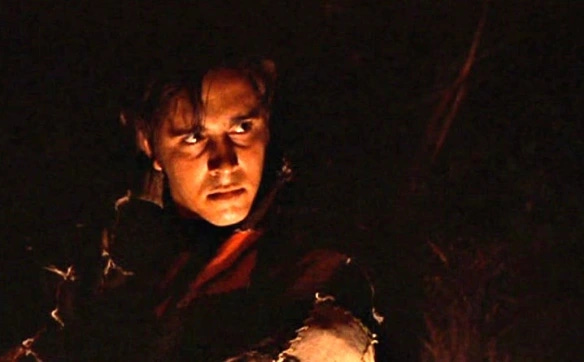
Drew eventually arrives in St. Joseph, Missouri, determined to travel west to make his fortune. There, Drew meets Jake Rumsey (Jeff Bridges), the “bad company” of the title. Jake is a young man around Drew’s age who also happens to be a con artist. Jake easily pickpockets some of Drew’s money shortly after meeting him. After Drew realizes what has happened, he and Jake get into a brutal fist-fight. Drew wins and gets his money back. The two argue.
Then, unexpectedly, Drew and Jake become friends.
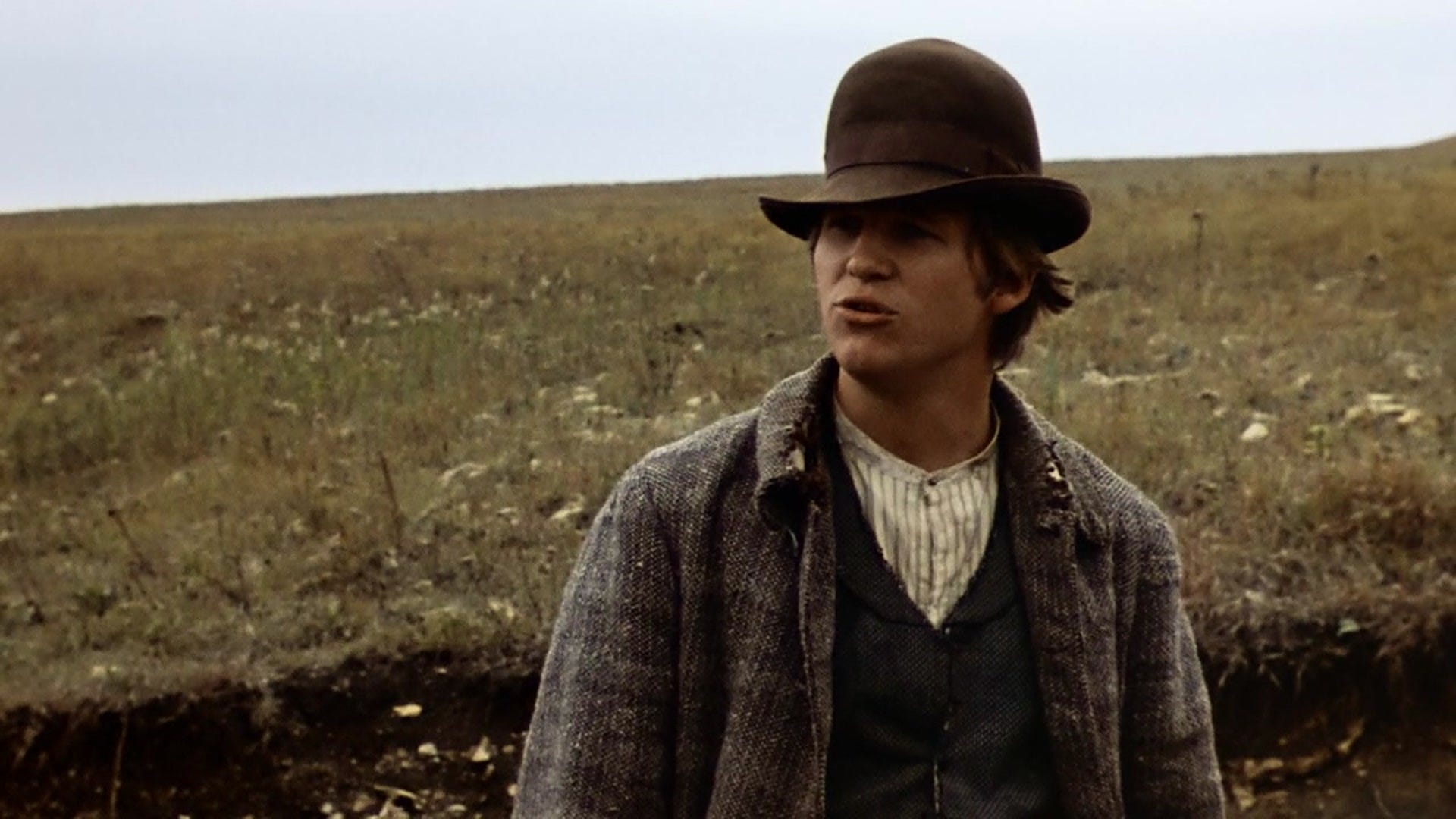
The two are polar opposites: Drew is educated, eloquent, well-dressed, and has high moral standards. In contrast, Jake is uneducated but crafty, wears tattered clothes, and as Drew eventually discovers, has no morals at all.
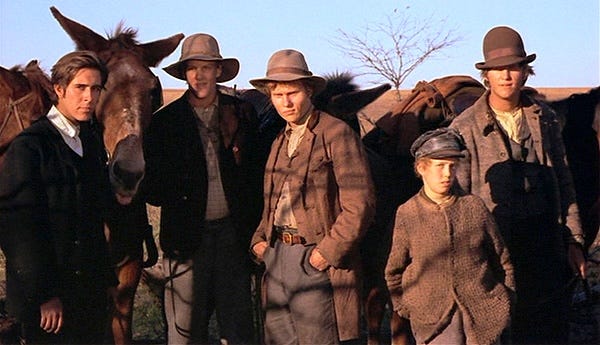
Jake is the Fagin-like leader of a group of teenage runaway misfits. They’re sort of a cowboy version of Peter Pan’s lost boys that include an 11 year old named Boog whose specialty is stealing home-made pies from open kitchen windows.
Impressed by Drew’s scrappiness in their brawl, Jake urges Drew to join his gang by saying all of the other boys were “hand-picked for their gumption” and proclaiming they’ll head west to earn their fortune by “living off the land.” Drew accepts Jake’s invitation but doesn’t share the fact that he has $85.00 hidden in his shoe.
As they prepare to leave, the young men worry about encountering Indians on their journey, but that turns out to be the least of their problems.
You see, once they leave civilization, Drew, Jake, and the other boys find themselves in a vast, empty land. Gordon Willis’s brilliant cinematography perfectly evokes the cruel beauty of this vision of the west: empty, desolate, and forlorn.
Ironically, the boys don’t encounter a single Native American throughout the film.
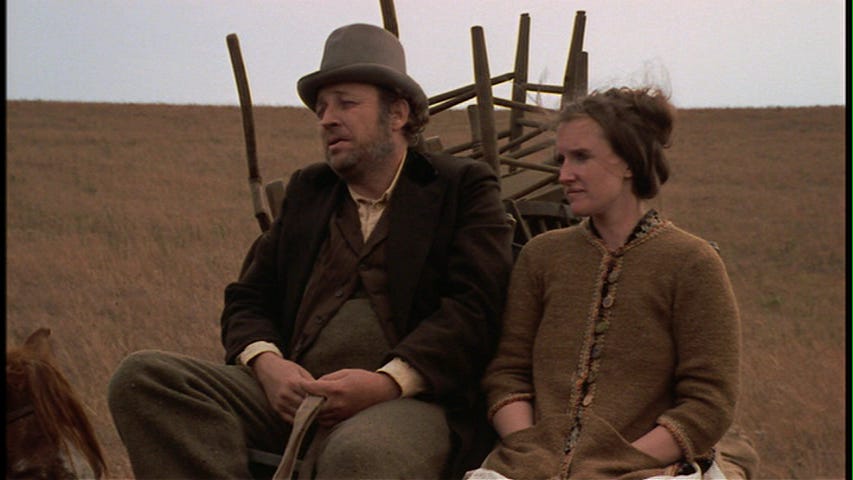
Instead, what follows is a picaresque portrait of a west sparsely populated by people who are either totally corrupt or have had bad luck and are disillusioned. For example, there is the married couple the boys encounter early in their journey. They are so desperate the wife willingly agrees to have sex with all of the boys for for only $8.00. (Only Drew and Boog, the youngest of the group, decline the offer).
Trying to help, the husband bluntly tells them, “Go back. You don’t know what you’re in for.” But the boys don’t listen to him.
It later becomes obvious that these boys, raised on tall tales of adventure like the exploits of Buffalo Bill, have neither the fortitude nor the skills to survive in the reality of the west. This is especially true when they encounter Big Joe and his gang.
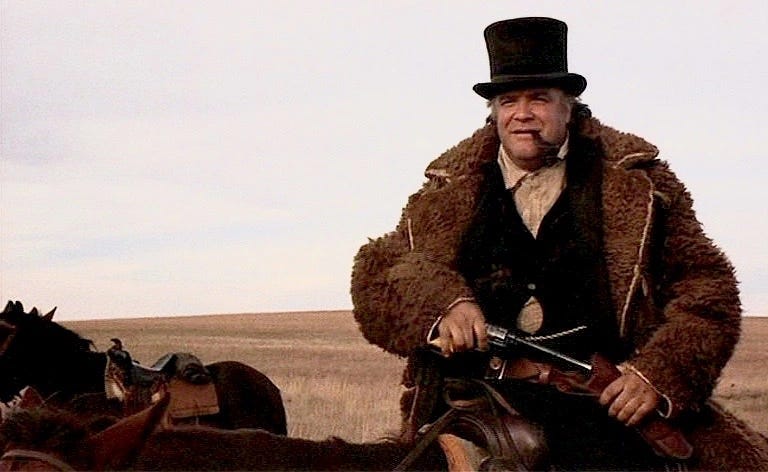
Brilliantly portrayed by character actor David Huddleston, (who years later would be the big Lebowski to Jeff Bridges’ Dude in the cult film of the same name), Big Joe is a towering figure; a Falstaff on horseback. He’s corrupt, cruel, and prone to violence; yet he also has a sense of humor.
After getting robbed of everything they own by Big Joe and his gang, the other boys are eventually killed or run away.
Soon, Jake and Drew are are the only ones left.
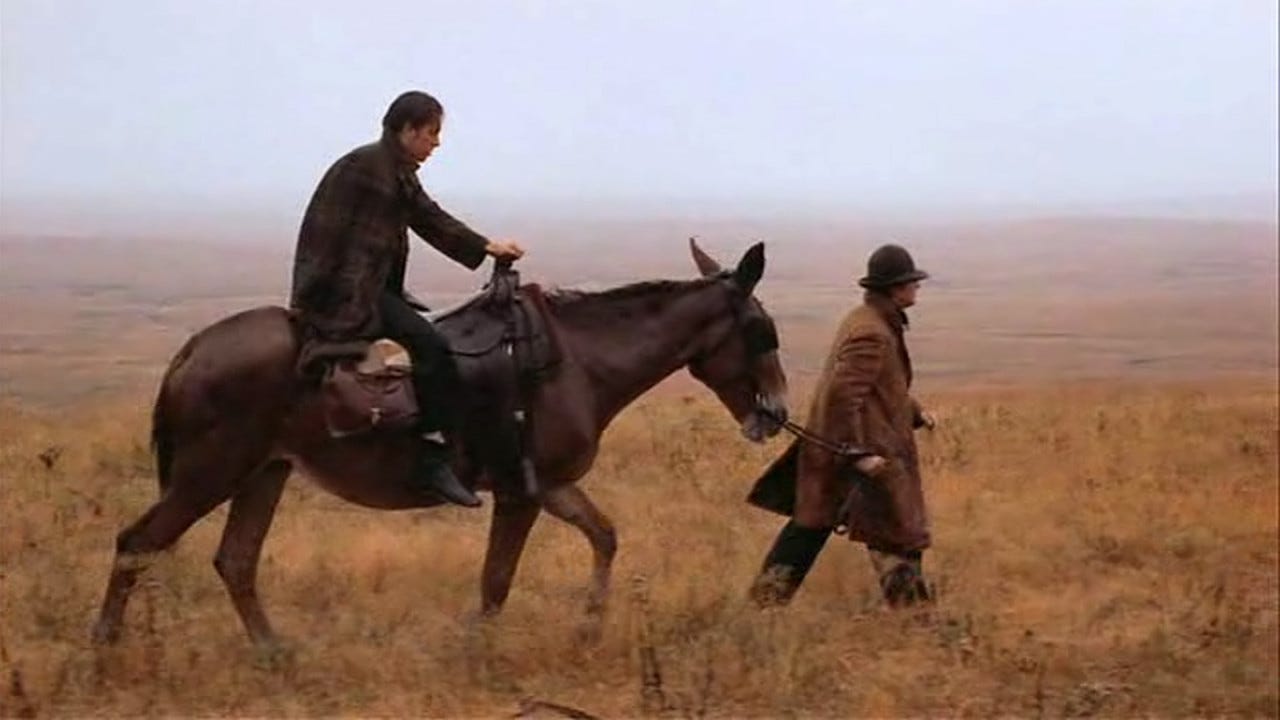
Later, during a second encounter with Big Joe’s gang, Jake and Drew manage to shoot everyone except Big Joe, who flees on horseback. Against the odds, the two boys have prevailed.
But after Jake discovers the money Drew has been hiding in his shoe, Jake forces Drew to give it to him at gunpoint. Then Jake rides away, leaving Drew to die alone on the empty plains.
But Drew doesn’t die. Eventually, Drew encounters a group of U.S. Marshalls and he joins up with them to arrest Big Joe and the members of his new gang, which now happens to include Jake.
It is here that the characterization of Drew becomes quite interesting. Throughout the film, Drew has touted his fine moral upbringing and religious beliefs. And, as Jake’s rakish behavior has become more evident, Drew has boasted about he’ll how enjoy seeing Jake hanged for his crimes.
Yet, shortly after Jake is arrested by the Marshall, Drew’s attitude suddenly changes and he begs the Marshall to spare Jake’s life. Of course, the Marshall isn’t buying any of it and insists Jake will be hanged the next day.
Later that night, Drew helps Jake escape and saves his life. Yet, the following morning, Drew awakens to find Jake about to sneak away with the horses and supplies. Once again, Jake shows his true nature.
The film ends with the two robbing a bank together. However, we don’t know if Jake and Drew are going to be successful in their new life of crime because the movie suddenly stops with a freeze frame that recalls the ending of Butch Cassidy and The Sundance Kid. My hunch is that Drew and Jake’s career as bank robbers won’t end well.
So why does Drew save Jake from getting hanged?
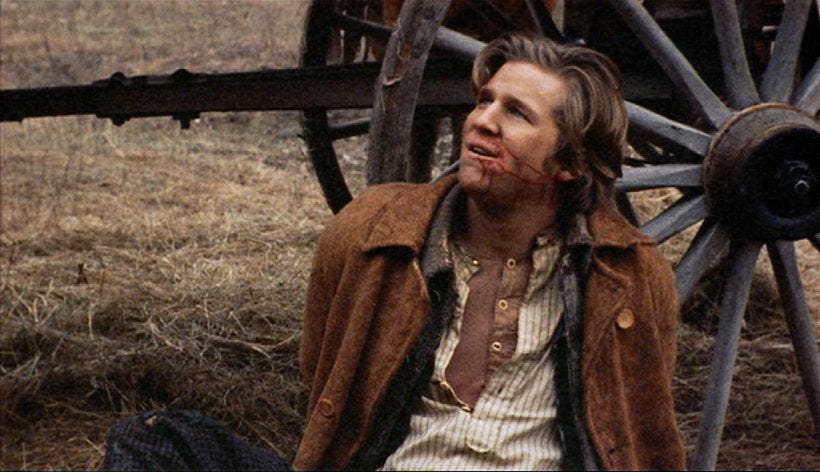
It could be that Drew isn’t as morally upstanding as he presents himself; after all, he did lie about robbing the hardware store for supplies (instead Drew bought them) and he did hide the money from Jake and the others throughout most of the film (not that money would do anyone any good out in the middle of nowhere). Or, it could be that being around the “bad company” of Jake has morally corrupted Drew without Drew even realizing it.
Ultimately, Bad Company is a remarkably assured directorial debut by Robert Benton. Benton’s control of the style and tone of the film is masterful, especially his use of violence in the film, which is always quick and unexpected.
In addition, the script for this revisionist western, while grim, also contains a fair amount of ironic humor, which makes the entire film enjoyable, even as viewers witness the terrible events and violence on the screen.
Benton also gets excellent performances from his cast, especially the late Barry Brown as Drew and Jeff Bridges as Jake. This was the first film Bridges made after his role in The Last Picture Show, and here Bridges is allowed to show his range in more detail as he portrays the rakish Jake.
In addition, Brown and Bridges have great chemistry together on-screen. It’s a shame they were never able to team up for another film. (Tragically, Brown committed suicide six years after Bad Company was released at the age of 27).
The supporting cast is also excellent, especially David Huddleston as “Big Joe,” Jim Davis as The Marshall, and in a very unnerving scene, character actor Charles Tyner as a very creepy egg farmer.
John Savage, Jerry Houser, Damon Cofer, and Joshua Hill Lewis (Boog) also give fine performances as members of Jake’s gang of runaway boys.
As mentioned above, Gordon Willis’ cinematography evokes a beautiful but cruel and empty west. Paul and Anthea Sylbert’s production design and costumes look so authentic I don’t know if they are relics from the era or if they were created for the film. In addition, Harvey Schmidt, best known as the composer for his musical, The Fantasticks, creates a simple, nostalgic piano score that is a nice counterpoint to the events happening on the screen.
Lastly, the film is tightly edited by Ron Kalish and Ralph Rosenblum with a running time of only 93 minutes.
At the time of its release, esteemed film critic, Pauline Kael trashed the film saying the movie, “gets off to a poor, slow start and and never takes shape.” She even hated Gordon Willis’ cinematography and called it “tiresome.”
In contrast, most of the other critics’ reviews were more positive. Roger Ebert said the film, “has a nice blunt, slice-of-life quality about it that grows on you.” In The Village Voice, Andrew Sarris said, “Benton’s directional tact is wondrous to behold.” And in The New York Times, Vincent Canby said Bad Company was “the year’s best commercial film by a new director.” Canby also praised the film for being “most entertaining in an elegiacal way.”
Newly restored and recently released on blu-ray for the first time by Fun City Editions, Bad Company is a hidden gem that’s worth rediscovering today.
A nice recap and review of a film that I had never heard of. Thanks for this. I look forward to reading more Notes From The 10th Row. I hope all is well.
You never fail to persuade me. This is a wonderful review. While I'm on my Western kick, I need to make time for this one.